Start a career

Your route into construction and engineering

From boots on the ground to the boardroom. Whether you are an aspiring carpenter, bricklayer, construction manager or planner, we will help you find the way in that fits your life.

Route finder

Three questions. Your own plan.

Tell us a little about you and we will suggest where to start, and how DIIC can help. Nothing is stored, and you can print or save your plan.

Question 1 of 3 · takes under a minute

Which of these sounds most like you?

Your options

Five ways in, none of them second best

Moving from a grammar school to college should not mean you are not smart enough. Every one of these routes leads to a rewarding career.

Option 1

College

Vocational courses in a trade or skill

Full or part time courses that teach the practical skills employers look for, from bricklaying to electrical installation. A strong start if you want to learn a trade before you look for work.

Good for
School leavers, career changers, anyone who wants hands on skills
How long
Usually one to two years

Option 2

T Levels

A two year technical qualification after GCSEs

T Levels mix classroom learning with a substantial industry placement. Moving from a grammar school to college should never mean you are not smart enough: a T Level is a serious route into the built environment.

Good for
16 to 19 year olds who want a technical start
How long
Two years, including an industry placement

Option 3

Apprenticeship

Earn while you learn

Work for an employer, get paid, and train toward a recognised qualification at the same time. Apprenticeships run from entry level up to degree level, in trades and in professional roles.

Good for
Anyone who wants to earn from day one
How long
From around one year to four or more

Option 4

Degree

University study toward professional roles

Degrees lead into engineering, surveying, architecture and construction management. Our education partners include Canterbury Christ Church University, which offers a BEng (Hons) in Building Services Engineering.

Good for
People aiming for chartered and professional roles
How long
Usually three to four years

Option 5

Certifications

The cards and tests that get you on site

Short courses and tests such as the CSCS card and health and safety tests prove you are site ready. DIIC helps people access free courses and, where funding allows, covers the cost.

Good for
Anyone who needs to start working on site soon
How long
Days to weeks

Guide

Compare all five routes side by side

Read the guide

Why it is harder for some

The barriers are real. So is the way through.

These barriers are doubly hard for people who belong to more than one marginalised group. We are here to tell candidates and decision makers alike: this has to change.

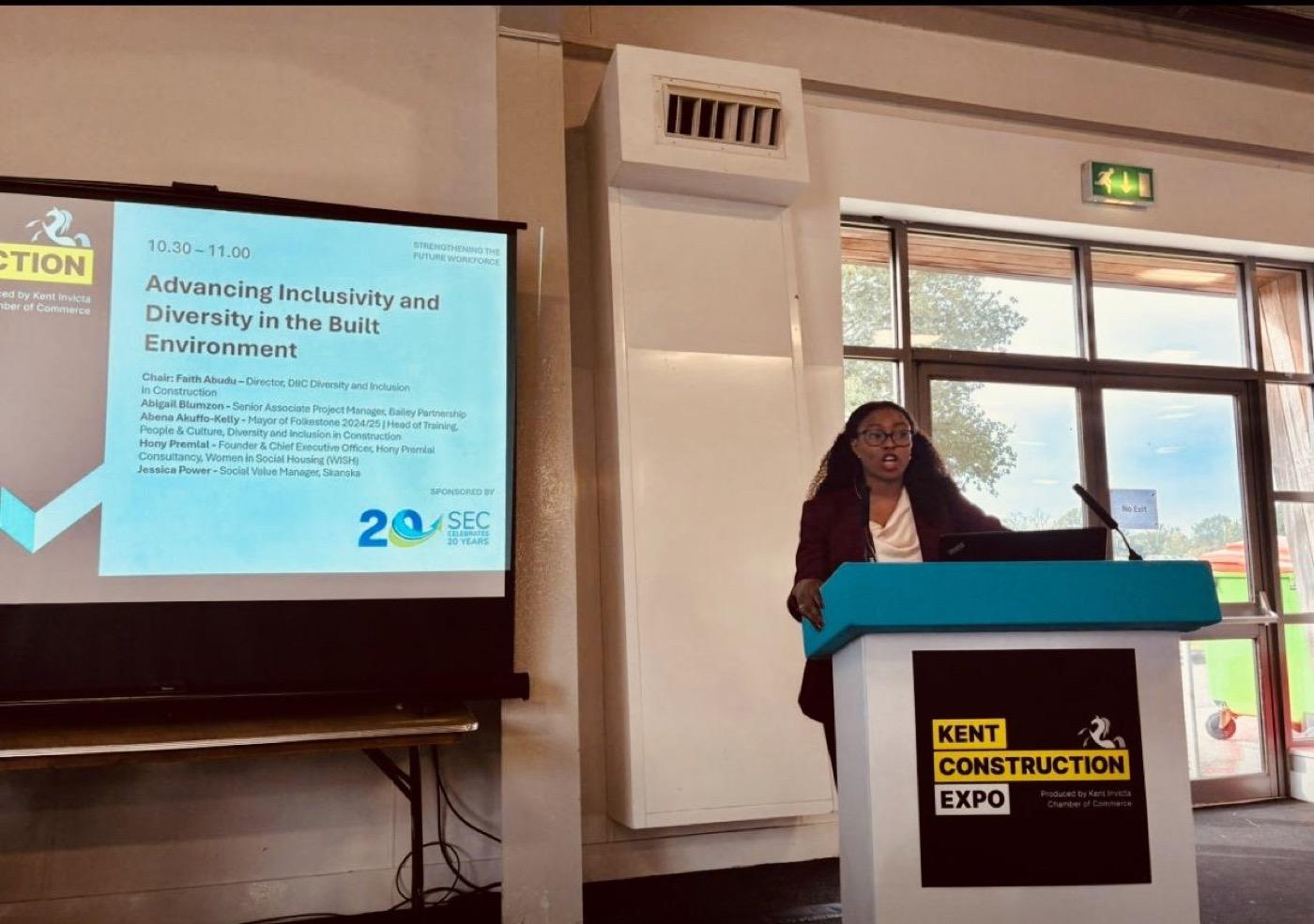
Faith Abudu chairing the EDI panel at the Kent Construction Expo 2025
  1. 01

    Unconscious bias

    Decision making can be shaped by bias people do not notice in themselves.

  2. 02

    Obstacles to entry

    Women, ethnic minorities and disabled people meet obstacles getting in and getting on.

  3. 03

    Homogeneity

    Management and decision making levels lack diversity, so many people never see someone like them.

  4. 04

    Recruitment challenges

    Many Black women never consider construction, often because of a lack of information or family support.

  5. 05

    Cultural and social factors

    Ideas about the industry, from muddy boots to job security, put people off before they start.

How we help

Practical help, from language skills to interview technique

Guidance on pathways

We walk you through courses, certifications and careers so you know your next step.

Job placement

We match nurtured, qualified candidates with employers committed to inclusion.

Free courses

Access to free courses, and funding for certifications where appropriate.

Free English classes

Free English for non English speakers who want to work in the industry.

Help with your CV

Practical help with CVs, applications and interview technique.

Changing career path

Support for women changing careers or returning after maternity leave.

Our education partners

Canterbury Christ Church University

School of Engineering, Technology and Design. BEng (Hons) Building Services Engineering.

courses@canterbury.ac.uk

Waterfront UTC, Gillingham

University technical college in Gillingham, Kent.

London South East Colleges

Further education and vocational courses.

studenthub@lsec.ac.uk

Do you need someone in your corner?

Reach out today to talk about your situation. We will help you take the first step.